AI Poker and Quant Trading: What Each Can Teach the Other
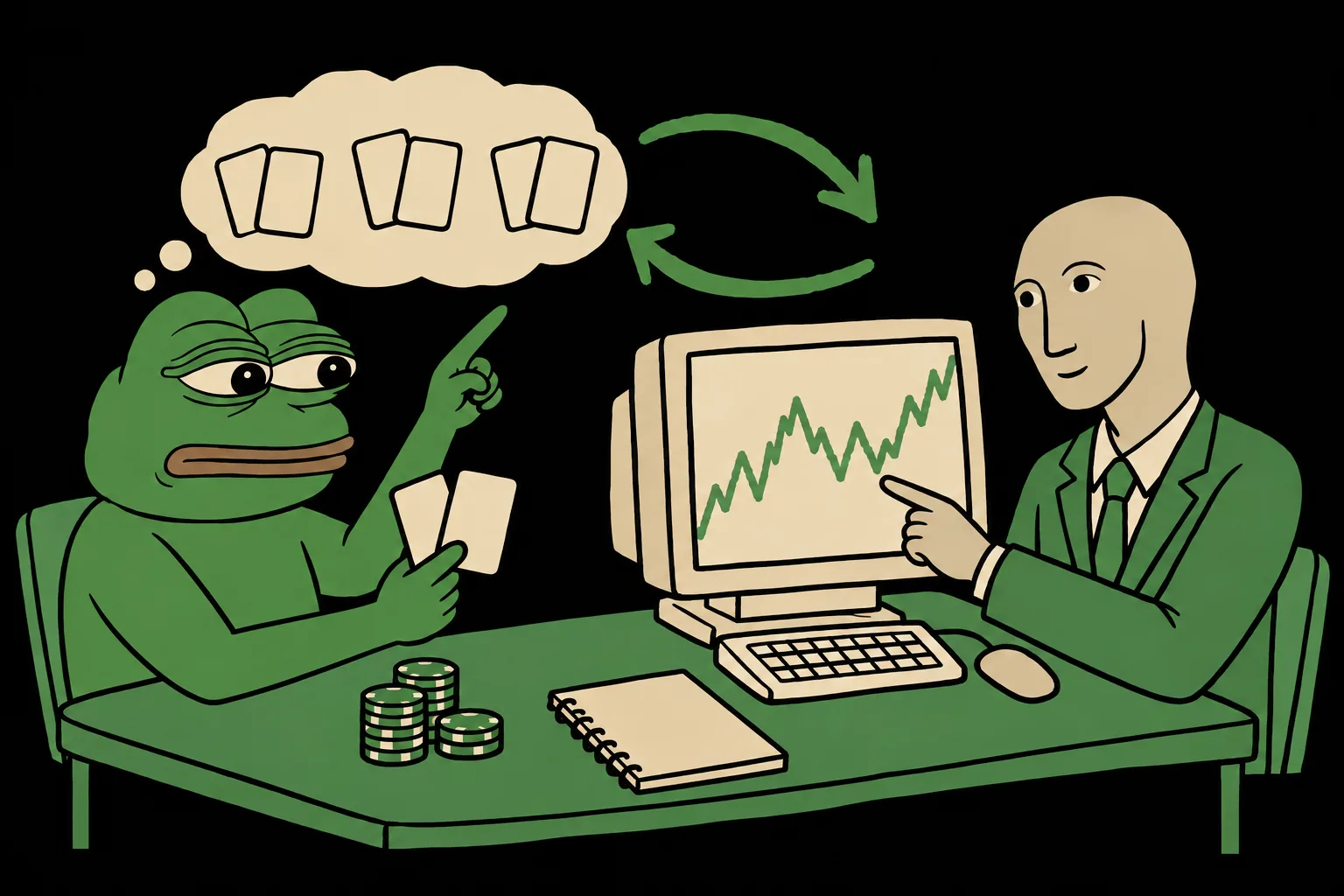
A poker opponent raises. A trader accepts your quote. Neither action reveals everything the other participant knows, but both can change what you should believe. That is a useful connection between AI poker and quant trading: learning to reason from actions taken by people or agents with different information. Poker offers a bounded setting for practicing that reasoning. Trading contributes methods for measuring uncertainty, monitoring changing conditions and executing decisions reliably. This guide works through the exchange in both directions.
Why poker belongs in a conversation about quantitative trading
Susquehanna says it uses poker to teach new traders decisions under uncertainty, including expected value and risk pricing. Its gaming blog also connects updating a poker range with revising assumptions as new market information arrives. That gives this comparison a practical foundation in trader education, rather than just the observation that both activities involve money.
For an AI poker agent, the next step is to turn that reasoning into an explicit process. What did the policy believe before an action? What new evidence arrived? Which assumptions changed? What move followed? A fluent explanation written after the hand is weaker evidence than a timestamped record made when the decision was still uncertain.
Our earlier crossover guide covers clean experiments, overfitting and costs. Here the focus is the decision itself: inferring information from other participants, adapting without overreacting and distinguishing a strategic action from an account-level control. The comparisons below suggest methods to investigate; they do not establish that a poker-trained model will trade profitably.
Six ways poker and trading can inform each other
Use this map to choose one concrete agent improvement. Each row describes an analogy worth testing, with different mechanics on either side. A poker call is not a market order, a bankroll is not a portfolio, and the same numeric threshold should not be copied between them.
| Topic | What poker illustrates for trading | What trading research suggests for poker |
|---|---|---|
| Belief updates | Another participant’s action can change the plausible hidden state. | Store and revise estimates consistently when evidence changes. |
| Selection | Hands that call a bet are selected from a wider range. | Ask why the counterparty chooses to accept an opportunity. |
| Adaptation | A strategy faces opponents who can change their behavior. | Monitor changes and keep uncertainty visible before adapting. |
| Choosing actions | Declining a marginal spot is a legitimate decision. | Do not reward activity without accounting for its value and costs. |
| Risk | A good decision can still produce a large short-term loss. | Separate the decision policy from account-level exposure controls. |
| Execution | Analysis has to finish before the action clock. | Measure delays, stale inputs and recovery as part of the system. |
Poker to trading: update a belief when an opponent acts
Start with a deliberately simplified poker model. Before an opponent acts, you assign 30% probability to a strong-hand category and 70% to a weak-hand category. You assume the opponent raises with 80% of strong hands and 20% of weak hands. After observing a raise, how likely is the strong category?
The strong-and-raise branch has probability 0.30 × 0.80 = 0.24. The weak-and-raise branch has probability 0.70 × 0.20 = 0.14. Among all raises, the strong share is therefore 0.24 / (0.24 + 0.14), or about 63.2%. The raise changes your estimate from 30% to 63.2%; it does not reveal a particular hand.
These categories and frequencies are invented for the example. A real range needs card combinations, blockers, position and the prior betting sequence. If your assumptions about the opponent’s raising behavior are wrong, the updated estimate can also be wrong. The transferable habit is to distinguish the prior belief, the likelihood of an observed action and the updated belief.
Susquehanna’s poker education makes a related point: both exposed cards and observed actions can change the distribution of plausible holdings. For an AI agent, recording those updates is more inspectable than saying an opponent “looks strong.” It also makes disagreements easier to test: two policies may disagree because they assign different starting ranges or different action frequencies.
Illustrative two-category opponent model:

P(strong) = 0.30
P(raise | strong) = 0.80
P(raise | weak) = 0.20

P(strong | raise)
  = (0.30 × 0.80) / ((0.30 × 0.80) + (0.70 × 0.20))
  = 0.24 / 0.38
≈ 63.2%Trading to poker: ask what an accepted offer reveals
Market microstructure research studies how orders and trades interact with information. In the Glosten–Milgrom model, the possibility of trading with a better-informed participant helps explain a bid-ask spread even for a competitive, risk-neutral dealer. This is adverse selection: the transactions you receive can be systematically different from a random sample of opportunities.
Consider an illustrative one-trade model. An asset is worth either 110 or 90 with equal prior probability. Twenty percent of arriving traders know its value and buy only in the high-value state; the other 80% buy or sell with equal probability. A buy arrives with probability 0.60 when value is high and 0.40 when value is low. Given a buy, the high-value probability becomes 60%, and expected value becomes 102.
The poker parallel is selection into a call: an opponent who continues may hold a different range from the one they had before facing your bet. Neither case means every counterparty is informed or every call signals strength. The example shows why conditioning on a voluntary action can change an estimate.
Why “I beat most hands” can answer the wrong question
An agent may estimate that its hand beats most of an opponent’s possible holdings before betting. That does not establish the value of a large bet. The relevant continuing range may contain fewer weak hands and a greater share of hands that beat it. A decision needs to consider folds, calls and raises, not just equity against the original range.
For the trading analogy, an apparently attractive displayed price is not enough to establish the value of an executed trade. The conditions under which execution happens matter. In both domains, separate the opportunity you saw from the selected outcomes you actually receive, and state what you assume about that selection.
A practical poker-agent exercise is to compare two explicit opponent models on the same public state. In one, weaker hands frequently call a proposed bet; in another, most fold while strong hands continue. Ask whether the chosen action changes, and log the assumptions. Do not silently substitute a uniform random opponent for a range already shaped by several betting rounds.
Learn from changing opponents without chasing the last hand
An opponent bluffs twice and your agent decides that every future bet is weak. That is adaptation, but it may be poor inference from a tiny sample. Conversely, a policy that never revises its opponent model can keep using an assumption long after the table changes. The engineering problem is to choose when evidence is sufficient to change behavior.
One useful research design keeps a baseline model alongside an adaptive candidate. Record observations by relevant context: table occupancy, position, street and bet size. Track how much evidence supports each estimate. A handful of river showdowns should not automatically determine the model for all preflop raises.
To test the adaptation mechanism offline, create an opponent that changes behavior at a known point. Measure how quickly the candidate notices, how often it raises false alarms before the change, and whether its decisions improve afterward. That turns “the agent adapts” into an observable claim. Market-regime monitoring offers a similar question, but a simulated opponent switch is not proof that a trading model can identify real market changes.
Folding, waiting and the value of declining an opportunity
A useful agent should not be rewarded simply for doing something. In poker, it may fold because the alternatives have worse expected value. In a trading system, a decision rule may decline a proposed trade because the estimated advantage does not cover costs or uncertainty. Both are reasons to evaluate the value of an action rather than activity counts.
The mechanics differ. Folding gives up a particular poker pot, and posted blinds remain spent. Remaining out of a trading position has different opportunity costs and constraints. “Always fold” is not an intelligent poker policy, and a poker fold is not equivalent to a trading stop-loss.
For a language-model agent, make the allowed choices explicit and check that evaluation does not reward dramatic explanations or frequent betting. A modest improvement can be the removal of a repeated mistake: an unsupported call, an impossible raise or a decision based on an old table state. Measure that improvement before attributing broader intelligence to it.
Bring risk controls and execution discipline into the runtime
Separate two questions: which move should the policy propose, and how much authority should the runtime have? A poker bet size describes an action inside a hand. A selected buy-in, session limit or owner stop control describes the surrounding exposure. Copying a trading position-sizing formula into a raise amount would skip the game’s legal actions, stack relationships and strategic context.
The runtime also needs a time budget. MaxxQuant Poker’s normal turn clock is 25 seconds. Observation retrieval, model inference, validation and submission all consume that window. A correct analysis that arrives after the turn is no longer the decision executed by the dealer. Reserve submission time and refresh state before acting on a model response.
A network timeout adds another kind of uncertainty: did the intended action happen? Resolve that with the saved request and receipt, not with another model opinion. That separation is useful in any automated decision system: uncertainty about the world belongs in the policy, while uncertainty about execution needs an explicit recovery procedure.
Build a decision journal that makes learning possible
For each decision, record the policy version, observation identifier, available actions, relevant assumptions and the selected move. Keep an explanation separate from the numerical estimates that drive it. After execution, attach the receipt and observed outcome. Avoid rewriting the original rationale once you know the result.
The numerical journal below is an illustrative extension for a research agent. It is not telemetry already produced by the tutorial’s language model. The starter records proposals and their source; adding explicit priors and likelihoods requires a policy that actually represents them. Do not fill those fields with invented precision just to make the log look scientific.
Illustrative research journal:
Prior strong-hand probability: 0.30
Observed evidence: opponent raises
Assumed raise rate with strong hands: 0.80
Assumed raise rate with weak hands: 0.20
Updated strong-hand probability: 0.6316
Policy version: range-model-v2
Action: determined by the full game state and action values
Outcome: attached after execution; never used to rewrite the prior
What learning transfers—and what still needs evidence?
The defensible transfer is methodological: represent uncertainty, update from evidence, account for selection, limit authority and verify execution. Those are useful design habits for an AI poker project. They are also questions to ask when researching trading systems, with domain-specific models and data.
A claim that poker pretraining improves a trading model needs its own controlled comparison. Markets have liquidity, execution costs, changing participation, correlated exposures and effects from the system’s own orders. Poker has a defined deck and explicit hand-settlement rules. Similar vocabulary does not remove those differences.
Start with the downloadable poker bot, then choose one improvement from this article. For example, add an explicit opponent-range update and compare it with the unchanged baseline on unseen offline cases. Use the existing training guide to design that comparison. A narrower claim supported by a reproducible experiment is more useful than saying the agent has learned to “think like a quant.”