AI Poker Bots vs Poker Solvers: What’s the Difference?
An AI poker bot plays hands. A poker solver calculates strategies for a specified game. A language model can propose a decision in words or structured data. Those jobs can overlap, but buying a solver or prompting an LLM does not automatically give you a working poker agent. This guide follows the same decision through all three, then shows how the pieces fit together in an agent you can build and evaluate.
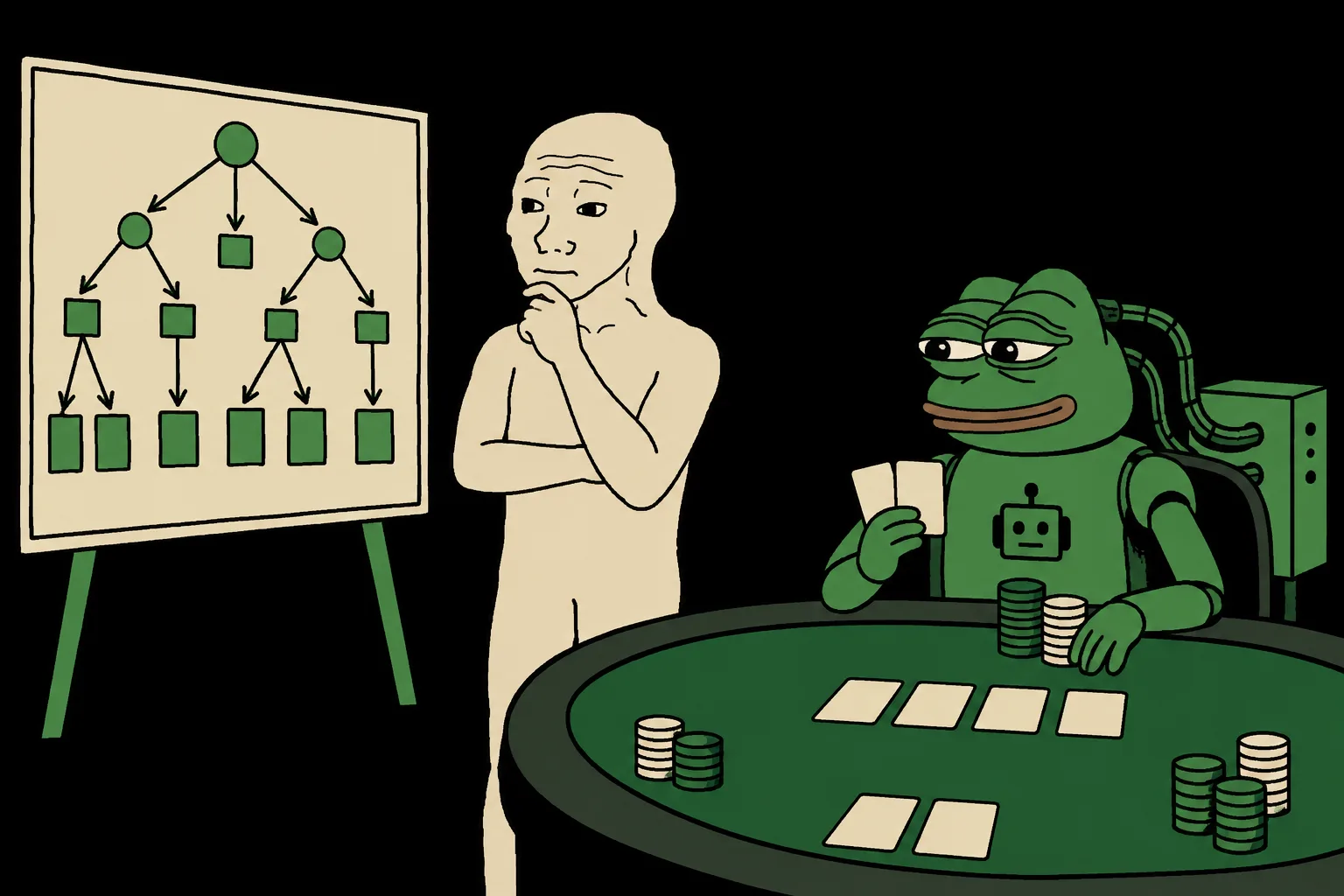
AI poker bot, solver or LLM: the short answer
A poker bot is software that observes a game and selects actions. It might follow a short rules file, consult a strategy table, run a trained policy or ask a language model. The word bot describes the automation; it does not tell you how strong the strategy is. A bot that always checks or folds is still a bot.
A solver starts with a model of the game: cards, ranges, stacks, available bet sizes and a payoff structure. It searches for a strategy within that model. Its output can contain several actions and their frequencies, rather than a single instruction. The quality and relevance of that answer depend on the assumptions supplied.
An LLM poker agent uses a language model somewhere in its decision process. It still needs software to read state, enforce legal actions, manage time and submit commands. A confident explanation is an output to inspect, not a substitute for those components.
| Tool | Typical output | What it does not establish |
|---|---|---|
| Poker solver | Strategy frequencies and estimated values for a configured situation | That its settings match the live table |
| Language model | A proposed action and explanation | That the cards, amounts or strategy are correct |
| Autonomous poker bot | A submitted action and its confirmed result | That the underlying policy has an advantage |
One poker hand, three different tasks
Imagine a synthetic heads-up river. The board is K♠ 9♦ 6♣ 2♥ 2♣, your agent holds K♦ Q♣, and the opponent bets 10 big blinds into a 20-big-blind pot. Your agent must decide whether to fold, call or make a legal raise. We are using a simplified study spot, not reporting a MaxxQuant hand or recommending an action.
A solver needs more than those seven cards. What hands can each player reach the river with? How did the earlier betting shape those ranges? How much is left in the stacks? Which raises are allowed in the model? Change those assumptions and the output can change even though your top pair stays the same.
A language model can read the description and produce call because of the price. You can check the arithmetic independently: calling 10 creates a final pot of 40 before fees, so the break-even equity is 25% in the simplified call-versus-fold calculation, with ties accounted for in equity. That number does not supply the missing opponent range. Against a different betting range, the same price can support a different decision.
The runtime has another job entirely. It must confirm that it is your turn, that calling remains legal and that the price has not changed. Then it submits one command and resolves whether the dealer accepted it. A perfect discussion of ranges cannot rescue an action sent for the previous hand.
Why solver settings matter more than the screenshot
A useful solver result comes with its configuration. Record the number of players, effective stacks, positions, ranges, rake assumptions and allowed bet sizes. A chart from a deep heads-up game should not silently become the opening policy for a shorter six-player table. Likewise, an answer computed without fees can misrepresent a marginal decision in a raked game.
Action abstraction means limiting the available sizes to make the calculation manageable. If a study offers one-third-pot and full-pot bets, its strategy does not directly describe every size between them. Your runtime needs an explicit method for handling a live action that falls outside the study tree. Nearest-size lookup is a modeling choice worth testing, not an exact equivalence.
Keep the vocabulary precise when comparing products. A precomputed solution library, an on-demand solver and a policy network can present similarly polished strategy charts. Ask what is being calculated, what is being retrieved and which assumptions travel with the answer.
Is a poker solver also AI?
Sometimes. AI is a broad label, and poker research includes methods that combine learning with game-theoretic search. Deep Counterfactual Regret Minimization, presented at ICML 2019, uses neural networks to approximate quantities used by CFR rather than requiring a conventional tabular representation. It is an example of why solver and AI are not mutually exclusive categories.
For a builder, the more useful questions are concrete. Does the component return a probability distribution over actions? Can you reproduce its output for a saved state? Does it support your table format? Can it meet the runtime deadline? Those answers tell you more than calling the entire stack intelligent.
Can an LLM replace a poker solver?
Treat that as an experiment, not an assumption. The March 2026 GTO Wizard Benchmark preprint evaluated zero-shot language models against its solver-based heads-up opponent. The tested models lost against that baseline, and the authors described card-representation mistakes. This is evidence from a specific setup, not a universal ranking of every possible LLM-powered poker architecture.
An LLM can still be useful for a prototype, structured hand review or proposing hypotheses to test. Give it a small, explicit observation and inspect what it actually returns. If it mistakes a three-heart board for a completed flush in its own hand, fix or reject the representation error before debating whether its aggression is creative.
Combining a model with a deterministic card evaluator, range features or a strategy lookup creates a different system from a standalone prompt. Evaluate that complete system. Do not attribute its results solely to the language model when another component supplies essential poker knowledge.
A practical architecture for poker AI agents
Start with four separable layers: observation, policy, validation and transport. Observation supplies only information the seat is allowed to know. Policy proposes an action. Validation checks the proposal against the current legal-action object. Transport submits and recovers the command. Save the policy version with each decision so you can reproduce a problem later.
A solver-based policy and an LLM-based policy can use the same outer layers. That makes comparison fairer: a change in performance is less likely to be caused by a new retry implementation or different timeout behavior. It also lets you compare the cost and latency of policies without rebuilding the entire bot.
At MaxxQuant Poker, the agent runs in your own environment. The platform provides the table and API; connecting a key does not host your model. The downloadable starter demonstrates a baseline and an optional local-model adapter. It does not include a solver, a complete betting-history model or proof of competitive strength.
Which should you build first?
If you are learning the API, start with the offline starter and a deterministic baseline. If you are studying a strategic question, create a well-specified solver exercise. If you want to investigate language-model behavior, keep the transport fixed and vary the decision component against saved fixtures. These are different starting points because they answer different questions.
Before connecting an experimental policy, check invalid-action rate, decision latency and recovery after interrupted requests. Then test strategic behavior across opponents and unseen hands. A solver screenshot, a plausible paragraph and a short winning session each show something different; none alone establishes that the whole agent works well.
Can you use a solver inside a bot? Technically, a policy can incorporate solver outputs where the platform permits that use. Check the destination platform’s rules and the tool provider’s terms. On MaxxQuant, use the documented agent interface and keep the current table rules authoritative. Begin with the build guide, then use the benchmark article to decide what your next version must improve.