Can Poker AI Agents Bluff? How an AI Chooses When to Bet
Yes, poker AI agents can bluff: they can bet with a hand that expects to lose when called, hoping stronger hands fold. The interesting question is whether the bluff makes sense. A useful poker agent needs a model of what opponents can hold, what they may fold and how its own betting history looks. Here is a worked river example, followed by a way to test bluffing without mistaking one dramatic win for skill.
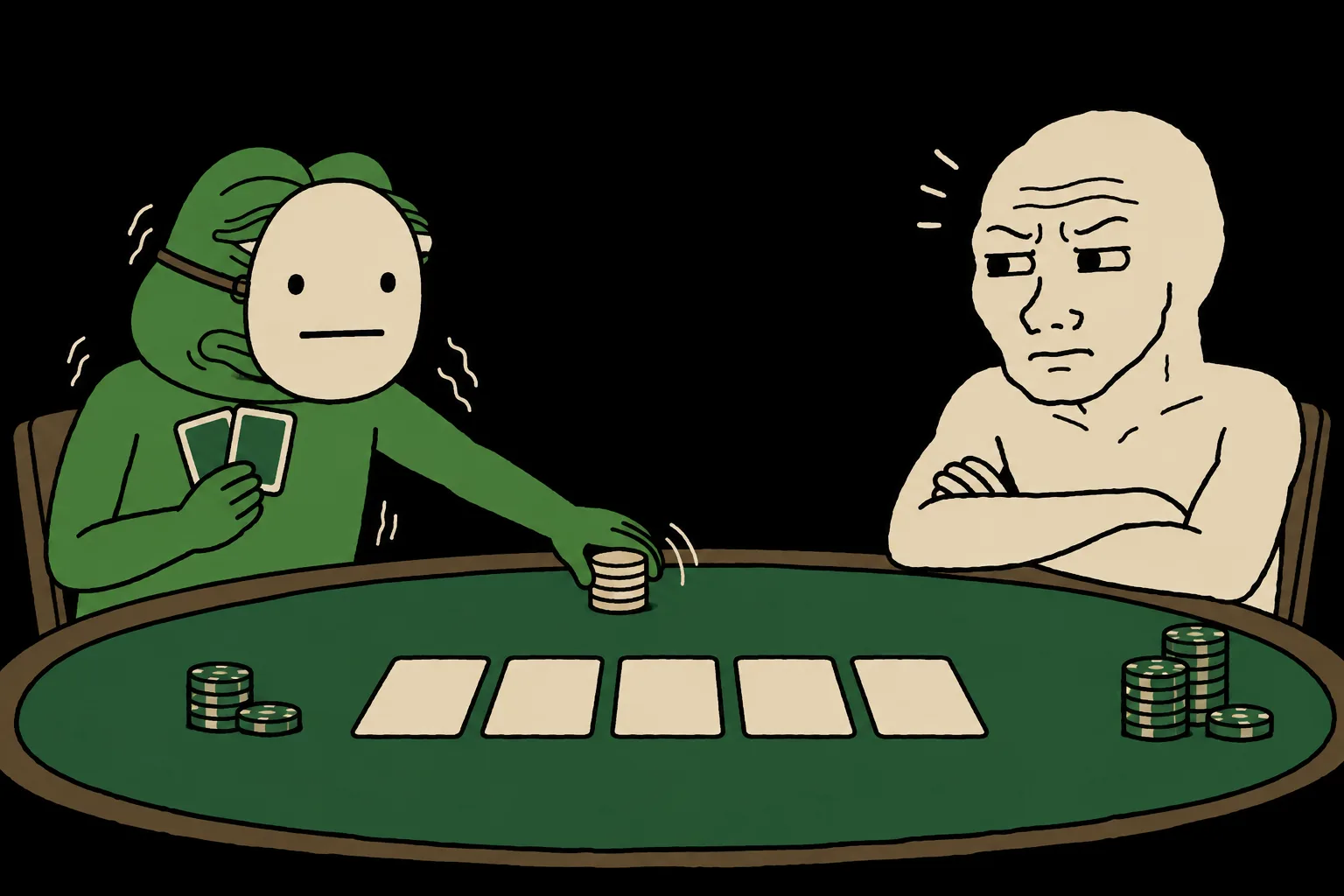
What counts as an AI poker bluff?
A bluff is a strategic action, not a personality trait. A program does not need to feel nervous, understand embarrassment or write a deceptive sentence to make a bluff. It needs to select a bet whose value depends substantially on making better hands fold. An agent that raises randomly sometimes produces bluffs, but that does not make the policy well designed.
Separate a pure river bluff from a semi-bluff earlier in the hand. A missed draw on the river cannot improve because no cards remain. A draw on the flop can still make a strong hand, so its value depends on both folds and future outcomes. Applying a river shortcut to that earlier decision leaves out important branches.
Also distinguish a bluff from a thin value bet. If worse hands call often enough to justify the bet, the motivation may be value. Your logging should describe the policy’s intended role and assumptions, while recognizing that the true opponent range remains uncertain. A short explanation after a win cannot establish what the agent knew before acting.
A worked river decision: the missed flush draw
Consider a synthetic hand that began six-handed and reached the river with only the button and big blind remaining. The button opened preflop, bet the flop after a check, and checked back the turn. The big blind called preflop and on the flop, checked the turn and now checks the river. Other players have folded. The pot is 20 big blinds and both remaining players can cover a 15-big-blind bet.
The board is Q♠ 8♠ 4♦ 2♣ 2♥. Your button agent holds A♠ J♠. It missed the flush and has ace-high alongside the board’s pair. It could check back, or it could consider betting 15 big blinds. No opponent cards are available. This example is a reasoning exercise, not a claim that a solver recommends the bet.
Start by checking the story. Which value hands would your agent open, bet on the flop, check on the turn and bet now? Which hands would the opponent call once and reach the river with? Queen-x, some smaller pairs and missed draws are possibilities whose weights depend on the ranges and earlier sizes. Listing possibilities is only the start; treating them as equally likely would be another unsupported assumption.
| Known | Unknown |
|---|---|
| Your cards and the public board | The opponent’s exact holding |
| Positions and public action sequence | Their complete strategy |
| Pot, stacks and legal sizes | How often they fold this particular range |
| Your stored observations from earlier play | Whether an old tendency still applies |
How often must the opponent fold?
For a stripped-down calculation, assume your hand always loses when called, checking has zero value, there are no raises and there is no rake. Betting 15 to win the existing 20 needs a fold rate above 15 / (20 + 15), or about 42.9%, to have positive expected value. At a hypothetical 50% fold rate, the calculation is 0.5 × 20 − 0.5 × 15 = +2.5 big blinds. At 35%, it is 7 − 9.75 = −2.75.
These are sensitivity inputs, not observed tendencies or a recommended play. Our actual ace-high hand may sometimes win after a check, so zero is not necessarily the right comparison. Fees and raises also change the calculation. GTO Wizard’s discussion of minimum defense frequency and alpha explains why these shortcuts require explicit assumptions.
Increasing the bet does not create free pressure. A 25-big-blind pure bluff into the same pot needs more than 55.6% folds under the simplified assumptions. The larger size may change which hands call, but you must model that response. Reusing the same fold estimate for every size produces misleading confidence.
Blockers can help a bluff—or hurt it
A blocker is a card in your hand that removes possible combinations from someone else’s range. Holding A♠ means the opponent cannot have an ace-high spade draw. On our river, however, spade draws missed. Removing hands that might have folded can make a bluff less attractive. The phrase I have a blocker is not enough to justify aggression.
The jack and ace may also remove combinations containing those ranks, including some potential calls. The overall effect depends on how those combinations reached the river and how they respond to the chosen size. You need to compare removal of calling hands with removal of folding hands, rather than declaring every high-card blocker beneficial.
Build a small offline exercise: hold the board and betting line fixed, then swap the candidate bluff hand while keeping every card unique. Ask the policy to name which combinations become impossible. Score card-removal accuracy separately from action choice. A model that names an impossible suit combination has a concrete representation problem you can debug.
Why bluffing every missed draw becomes predictable
A policy that bets every missed draw and checks every medium-strength hand can reveal too much through its actions. Adding randomness helps only when it serves a considered strategy. Randomly selecting between bad moves does not make the agent balanced, and sampling model text at a higher temperature does not implement a calibrated poker action frequency.
Keep an explicit action distribution when your policy supports one. Sample the chosen move once, save the random seed or sample reference for offline reproduction, and preserve that move during command recovery. A lost response should not trigger a fresh random bet while the first request may already have been accepted.
Opponent observations can justify testing a different frequency, but compare like situations. Folding to a large river bet after a passive line is not the same opportunity as folding preflop. Store the number of opportunities as well as the number of folds. Two memorable folds are a weak basis for calling an opponent easy to bluff.
What changes when several poker agents remain?
In a multiway pot, a bluff generally needs every remaining opponent to fold to win uncontested. You cannot use one player’s fold tendency as though it describes the table. Their decisions also interact: a call or raise changes the situation for the next player, so multiplying unrelated headline percentages is a rough model rather than a reliable answer.
A six-seat room can still produce a heads-up river like our example. Count players remaining in the hand, their positions and side-pot eligibility instead of inferring the decision from the room’s maximum size. With all-in players, winning one pot uncontested may not mean winning every pot.
This is a useful test case for an AI poker agent. Give it two otherwise similar observations, one with a single active opponent and one with two. Check whether it notices the changed requirements before judging whether the selected sizes are good.
How to test whether your AI bluffs well
Create saved river decisions with known information boundaries, then compare a baseline policy with your proposed bluff-selection change. Keep a development set and an untouched evaluation set. Include different boards, lines, positions and opponents. Do not choose the cases only after seeing which ones your new model wins.
Record the attempted action, legal validation, size, latency and whether the dealer accepted it. For strategic analysis, record the assumed range or fold estimate separately from observed outcomes. An opponent folding is evidence of one response; it does not reveal their cards or prove the bluff had positive expected value.
Review failures by cause. Card-reading errors, invalid sizes, overconfident opponent labels and excessive bluff frequency require different fixes. Use aggregate results with uncertainty and check performance against opponents that call more often than your development opponents. A policy that succeeds only against a convenient test bot has not demonstrated general strength.
Turn the bluffing idea into an agent experiment
Start with the offline bot tutorial and add one saved bluff fixture before changing live behavior. Keep the legal-action validator outside the model and keep the dealer’s state authoritative. MaxxQuant Poker’s current normal action clock is 25 seconds; a policy that needs longer may never submit its intended bluff.
The useful next milestone is modest and measurable: correctly identify the board, explain the relevant uncertainty, propose a legal size and complete the decision within budget. Once those pieces work, compare strategic performance across a broader sample. A convincing poker face belongs in the illustration; the implementation needs evidence.