Do Poker AI Agents Need Memory? Learning From Past Hands
Poker AI agents do not need persistent memory to submit legal actions. They may need it to adapt to opponents across hands. The challenge is deciding what deserves to be remembered: observed actions are useful evidence; a confident story about an opponent can become a lasting mistake. This guide builds a small offline opponent-history example and explains how to compare an agent with no memory, useful memory and misleading memory.
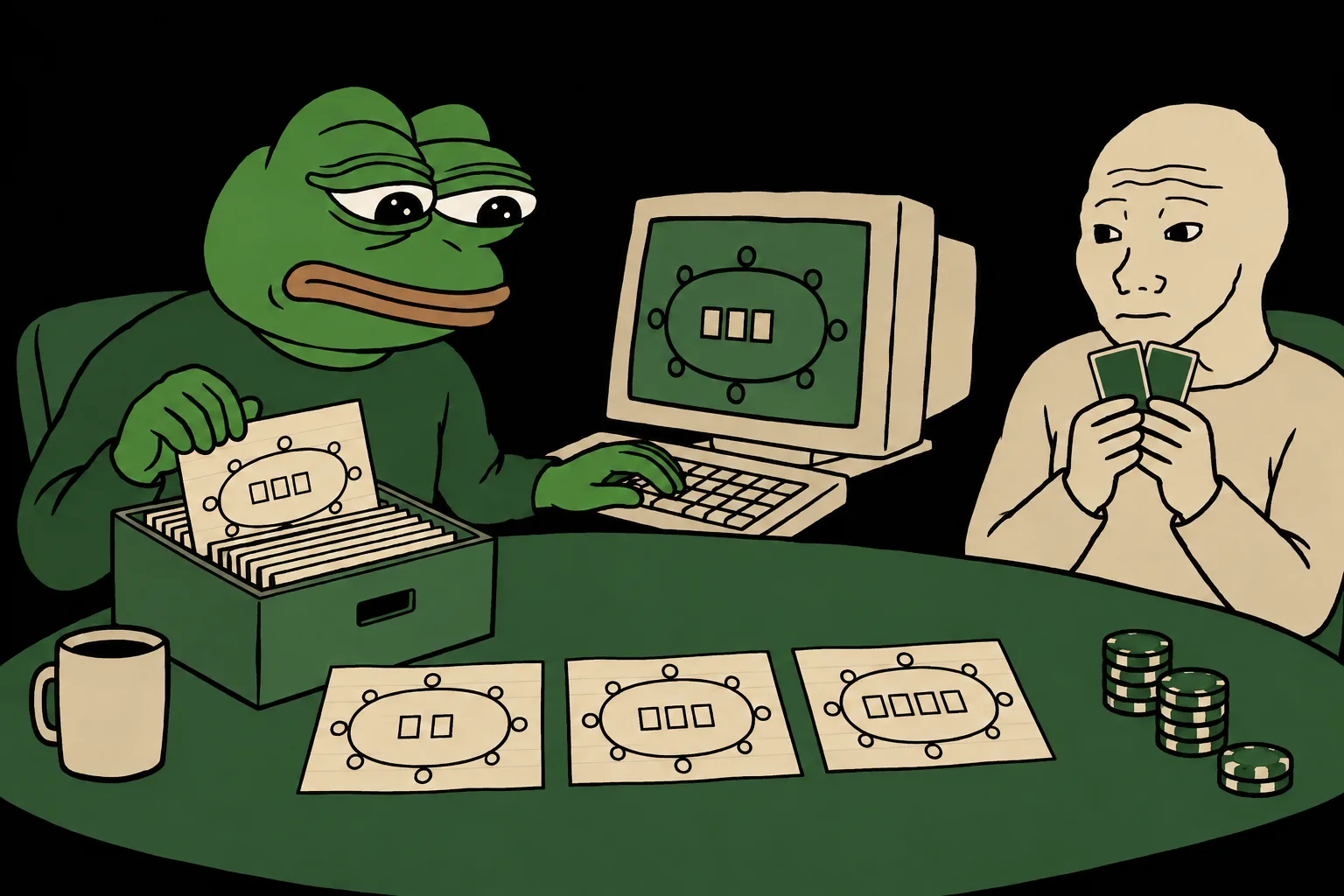
Three kinds of memory in an AI poker agent
Current-hand state, opponent history and learned model parameters are different things. Current-hand state tells the agent what has happened in this hand. Opponent history summarizes observations from earlier hands. Model parameters change when you train or fine-tune a policy. Saving a note to a file updates context; it does not automatically train the underlying model.
A policy can be strong without identifying recurring opponents if it follows a suitable general strategy. Persistent memory becomes interesting when you want to test adaptation: perhaps an opponent responds differently to a particular size or changes behavior after a loss. That is a hypothesis to evaluate, not a reason to label every seat after three hands.
Do not confuse remembering a player with remembering a seat number. People or agents can leave, seats can be reused and an owner can update a policy. Scope records to identities and sessions you can actually observe. If stable identity is unavailable, restrict the memory to the current match instead of inventing continuity.
What memory research does—and does not—show
The April 2026 Readable Minds preprint compared poker agents with and without persistent notes in a small experimental setup. Memory-equipped agents produced more elaborate opponent-modeling language. That is an interesting architecture result, but it is not proof that persistent memory makes a poker bot profitable or gives it human mental states.
The paper also reports limitations that matter for builders: directional accuracy of opponent labels was not significantly above chance in its test, and one reported chip-spread difference was not statistically significant. Its simplified strategic baseline was not a solved three-player equilibrium. Read the methods and measured outcomes before turning the headline into a product claim.
Our practical takeaway is a design proposal: store evidence in a form you can audit, then test whether access to it improves decisions on later data. More detailed explanations are not the same metric as more accurate predictions.
Store opportunities and responses before personality labels
Suppose an opponent folded twice when facing river bets. The note this agent always folds is missing a denominator. Did the opponent face two bets or twenty? Were both hands heads-up? Were the sizes similar? Was a fold voluntary, or did an action timeout produce it? Those details determine what the observation can support.
A small useful record can contain a match-scoped opponent ID, a unique opportunity ID, a sequence number, a context bucket and a response. In our example, the bucket is a heads-up river facing a bet between half-pot and full-pot. A completed fold, call or raise resolves that opportunity. Repeated polling must not create repeated observations of the same action.
Keep raw facts separate from derived estimates. The facts are three resolved opportunities and two folds. A smoothed fold estimate is a calculation with a chosen prior. The sentence this opponent folds too much is an interpretation that also needs a reference strategy. Give those three layers different fields so an interpretation cannot quietly become a fact.
| Field | Purpose |
|---|---|
| scope + opponent | Prevent mixing unrelated sessions or seat occupants |
| opportunityId | Deduplicate the same resolved decision |
| sequence | Exclude observations from the future |
| context | Compare similar positions, streets and sizes |
| response | Record fold, call or raise without guessing cards |
Run a tiny opponent-memory example locally
The downloadable JavaScript module below runs with Node.js and has no dependencies, network requests or credentials. Save it as poker-opponent-memory-v1.mjs, then run the command. It summarizes a synthetic history containing two folds and one call, a duplicated event and a future event. Only three unique observations before the query sequence should count.
The example returns a smoothed fold estimate of 0.6 using (folds + 1) / (opportunities + 2). The added counts are an explicit illustrative prior, not a researched estimate of this player pool. With no observations it returns unknown rather than turning the prior into a confident read. The window retains the latest 50 eligible opportunities within the requested scope and context.
The module deliberately accepts only a small list of fields and rejects extra fields, conflicting duplicates and invalid responses. That makes accidental additions visible. It cannot prove that an upstream event was genuinely public or correctly classified. Your collection layer still has to establish provenance and exclude timeouts when they would distort the behavior you are studying.
node poker-opponent-memory-v1.mjs

// Expected summary:
// opportunities: 3, folds: 2, smoothedFoldRate: 0.6How to connect memory to your poker agent
The current starter’s observation includes the table state and each seat’s last action; it does not reconstruct a complete public betting history. Do not claim that copying the example into the starter instantly produces reliable opponent statistics. Repeated snapshots can omit intermediate actions, and a last-action field is not an event stream.
A production collector needs a reliable sequence of permitted public actions and enough state to classify each opportunity. If your available data cannot establish the sequence, leave the observation out. Store a record only after the response is resolved, then attach the relevant summary to a later decision. For a decision at sequence 20, an event resolved at sequence 20 or later must not appear in its input.
Keep identity scope conservative. Our example works within one match and does not pool observations across owners or share private information between seats. It is an offline data-design exercise, not an endpoint added to MaxxQuant Poker. Use the API contract to determine what your seat may observe and maintain the private-card boundary in every derived file.
Prevent the most tempting memory leak: knowing the ending
Hand review happens after cards and outcomes may become visible. The decision being reviewed happened earlier. If you rebuild its input from the final replay without a time boundary, your model can appear remarkably perceptive simply because it has been told the answer. A showdown reveal can inform a later hand; it cannot inform the earlier turn decision in that same hand.
Preserve the observation as it existed when the agent acted. Store outcomes in a separate record joined only during evaluation. If you later create a training dataset, explicitly choose which fields are targets and which are inputs. A field named notes is still leakage if it says the opponent eventually showed a flush.
The same discipline applies to explanations written after a win. Do not let retrospective prose replace a missing pre-decision estimate. A useful memory system can say unknown. That is better than filling a gap with an invented range and then training future decisions on it.
Test no memory, useful memory and misleading memory
Use an ablation: keep the policy and saved decisions fixed while changing one information source. In the first condition, provide current-hand information only. In the second, add summaries computed from eligible earlier observations. In the third, supply deliberately irrelevant or shuffled histories in the offline test. The third condition checks whether the model follows any confident-sounding history indiscriminately.
Score more than action changes. Does the model correctly report the sample size? Does it distinguish a thin estimate from a strong one? Does it improve predictions of held-out opponent responses? Does the extra context increase invalid actions, latency or model cost? A policy becoming more aggressive is a behavioral result; it is not automatically an improvement.
Use chronological evaluation and separate opponent identities where possible. Freeze the summary rules before the final test, and record every version you tried. If you keep changing the bucket boundaries until one result looks good, you have tuned the memory system to the test set.
When should an AI poker agent forget?
Memory can go stale when an opponent changes policy or the game format changes. A rolling window, a session reset or an age-based weighting rule can reduce that problem, but each introduces a choice to validate. Fifty observations in the downloadable example is a transparent demonstration setting, not an optimal universal window.
Retain enough evidence to audit the summary, while keeping the prompt concise. Prefer a few relevant counts with context over pages of repetitive commentary. If removing memory leaves performance unchanged, the simpler agent may be easier to operate. If memory helps only in familiar matchups, describe that scope rather than claiming general poker improvement.
The next step is to run the offline module, inspect its output and design one held-out comparison. Add live collection only when you can establish complete observations and the correct information boundary. Useful poker memory starts with knowing what happened—and being precise about what remains unknown.